The Back Story
How Opa Actually Creates His Cartoons and Caricatures
So... Does Opa Really Draw These Cartoons?
That's probably the most common question we hear people say these days.
The short answer is:
Yes. Absolutely…
But with some explanation. Opa has been drawing cartoons for more than sixty years. He estimates that he has probably drawn somewhere around 30,000 cartoons (just a guess—probably on the low side), caricatures, and humorous illustrations in the course of his life.
But that's only part of the story. The better question might be…
How does Opa create cartoons today?
The answer is that Opa combines old-fashioned artistic talent with modern technology to create something that is both original and uniquely his own.
It All Starts With Drawing (Still)
Long before there were tablets, iPads, apps, or artificial intelligence (AI), there was a pencil—and Opa used it (and still uses it).
Opa spent decades drawing live caricatures at business conferences, military events, motorcycle rallies, antique car shows, truck stops, senior citizen gatherings, fairs, festivals, and just about every other gathering you can imagine.
In time, Opa developed what he called a "quick draw" caricature style. The quick draw enabled Opa to sketch a rough, head-and-shoulders caricature… add ink… create translucent shadows with a special set of pens… and complete the entire piece in less than five minutes.
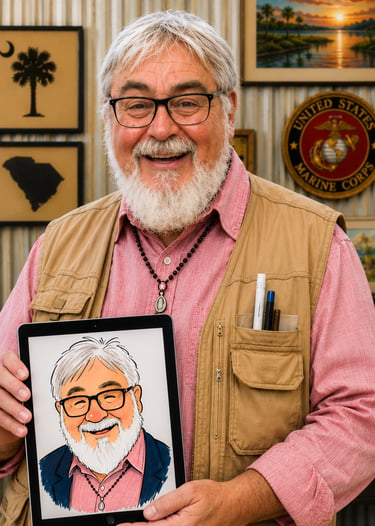
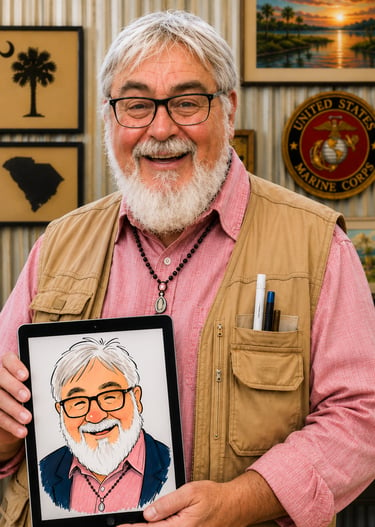
He usually did them on a pad of cartoon stock, either 4x6 or 5x7. And when the iPhones came out, he would have the subjects hold those caricatures beside their face so he could take a picture of the real person and the caricature together—for others to see.
People loved them (most people, anyway—there was always that one or two who did not see the likeness). For the most part, the drawings were energetic, personal, and full of character.
But they were still limited by the tools available to Opa at the time.
Then Came The Digital Art Age
As technology advanced, Opa embraced it—and Opa’s caricatures got better because he did!
Programs and apps, likes Adobe Photoshop, Adobe Fresco, Adobe Express, Procreate, and Clip2Comic all opened doors to entirely new possibilities for Opa. Digital tools allowed Opa to correct imperfections, refine compositions, experiment with colors, and achieve a level of polish that simply wasn't practical with paper and markers alone.
But here’s the point:
Technology didn't replace Opa’s drawing… It expanded what Opa’s drawing could become.
The artist was still there.
The pencil was still there.
What had changed was that there were now more tools available on Opa’s cartoon workbench.
And Then Came Artificial Intelligence (AI)
Like many artists, Opa was curious about AI.
He uploaded photos and let AI do its own thing.
He typed prompts.
He asked AI to create cartoons.
The results were often interesting… Sometimes even fascinating and impressive.
But something was missing.
Anyone could turn a photo into a cartoon-like image, but all of those cartoons looked pretty much the same. Most of what Opa saw just didn't feel like Opa cartoons. And Opa is a pretty creative guy..
There was no artistic fingerprint.
No personality.
No heart.
Opa was tempted to walk away from AI altogether.
Then he realized something important:
The missing ingredient wasn't technology.
The missing ingredient was authorship.
Creativity.
Opa‘s Secret Ingredient: Writing
Many people know Opa as a cartoonist. Fewer know that he is also an accomplished writer.
Over the years, Opa has published extensively—fiction (almost-true stories), technical writing, feature stories, news stories, editorials, business bids, and other stuff. He actually won some awards and earned some pretty good cash from his writing. Opa spent a lifetime learning how to communicate ideas not only with a pencil and sketchpad, but also through words.
And that writing skill became the bridge between traditional art and modern technology.
For six months or more, Opa devoted himself to studying AI image creation. Day after day, he wrote prompts, revised prompts, tested ideas, refined descriptions, and experimented with styles. He sketched… used words to describe his sketches… used more words to describe how those sketches would look if they were painted with water colors, oil, and other media. And finally, Opa reached the point where he had a few (shall we say) proprietary prompts (3-4 pages of descriptions and directions) that, when coupled with a reference image (for example, an Opa rough sketch), a picture came forth that was pretty close to what Opa was striving for.
Thousands of revisions later, something remarkable happened... He developed a process that consistently reflected his own artistic voice.
Now Opa thinks… and he draws… and then he thinks about what he is drawing… and then he writes complex messages (prompts) to AI to explain what he is thinking about—and most of the time, he also uploads his sketch’s to visually show the AI machine what he is thinking about—what it looks like in his mind’s eye. The result…
The new technology became a powerful tool for Opa, but not a substitute for his creativity or his “folk art.”
Opa Cartoon Technique Today
Each cartoon is a little different, but these days, a typical cartoon or caricature often begins the same way it always has:
With a sketch.
Opa draws.
He experiments.
He refines.
He explores ideas on paper or digitally until he discovers something he likes.
Then he does something many visual artists never seem to do:
Opa writes!
Like a movie director or playwright (that’s really what the process is like), Opa takes those sketches (let’s call them storyboards for now) and Introduces his characters and humor to the AI, carefully describing his thoughts and ideas; and his characters, their expressions, poses, environments, emotions, and the visual style he wants to achieve.
In other words, as Opa likes to say, he “sketches” his ideas and then "wordsmiths" his artwork.
Those written descriptions become part of a carefully developed creative process that incorporates sketches, artistic direction, digital editing tools, and AI-assisted image generation.
Reference drawings may be uploaded.
Custom style instructions may be applied.
Multiple versions may be explored.
Elements may be refined in Photoshop, Fresco, Express, and Procreate.
And yes, those dreaded three-legged characters (complements of AI) do have to be dealt with and fixed too. And that requires his knowledge of photo-editing and use of various apps too.
The result is not a picture that was simply generated, but a piece of artwork that was carefully crafted.
It is crafted!
Why Opa Calls It A Craft
When people hear the word "craft," they sometimes think of a hobby. That's not what we mean, however. A craft is the combination of talent, experience, skill, judgment, creativity, and tools.
A master woodworker uses saws.
A photographer uses cameras.
A musician uses instruments.
A cartoonist uses whatever tools help bring an idea to life.
Today, that toolbox includes pencils, pens, digital art programs, writing skills, image editing software, and AI.
None of those tools replaces the artist… but in Opa’s case, at least, they extend what the artist can do (and already has been doing for decades).
More Human Than Ever
Ironically, modern technology has made Opa's cartoons more personal, not less.
Every cartoon still begins with imagination.
Every caricature still begins with observation.
Every joke still begins with a human idea.
The technology helps bring those ideas to life, but it doesn't create them… that's still Opa's job.
So Does Opa Draw? Yes!!!
He draws.
He writes.
He sketches.
He edits.
He experiments.
He refines.
He imagines.
He laughs.
And he uses a few remarkable tools to help him along the way.
That's how Opa creates cartoons today.
Or as we like to say around here:
Opa doesn't just draw cartoons like he once did—these days, Opa crafts cartoons.
Our Story
That’s our story, and we’re sticking to it
Come on in and enjoy watching what Opa does with that story!

Subscribe to our newsletter
Enjoy exclusive special content available only to our subscribers.